

Burmese Food ✦ Culture
Htamin let thok is a Burmese rice dish mixed by hand with a savoury topping of peanuts, sesame, fried onions and spices. It is street food, home food and packed lunch all at once, and it is the dish behind every jar of Thami Letto.
Htamin let thok at a glance
- Meaning: rice mixed by hand. Htamin is rice, let is hand, thok is a mixed salad.
- Other spellings: htamin thoke, htamin let thoke, htamin lethok.
- What it is: warm rice, and sometimes noodles, mixed with a crunchy, savoury topping.
- Main flavours: roasted peanuts, toasted sesame, fried onions, gram flour, fish sauce or dried fish, lime.
- Served: warm or at room temperature, often finished with coriander, raw onion and lime.
Walk through a market in Yangon or Mandalay in the morning and you will find vendors selling htamin let thok from large shallow bowls. People gather round, the topping goes onto the rice, and the whole thing is mixed together by hand. It is quick, filling, cheap and full of flavour.
The name breaks down simply. Htamin means rice. Let means hand. Thok means salad or mixed. Htamin let thok is, at its most literal, rice mixed by hand. But that translation does not come close to describing what this dish actually is.

What goes into htamin let thok?
The base is plain boiled rice, usually still slightly warm. Some versions add noodles as well. From there, the toppings are where the flavour comes from. A traditional spread might include fried onion oil, fish sauce, roasted peanuts, sesame seeds, gram flour, crispy dried shrimp, and sometimes potato or boiled egg. Every family and every vendor has their own version.
The key to the whole dish is the topping mixture. A good htamin let thok topping is savoury, nutty, a little crispy and very aromatic. It does not just sit on the rice. You mix it in until every single grain is coated. The rice absorbs the oil, the spices cling to each grain, and the peanuts and sesame give crunch in every mouthful.
Htamin let thok belongs to a whole family of Burmese mixed salads called thoke. Our sister site has a guide to Burmese salads and thoke if you want to see the others.
It does not just sit on the rice. You mix it in until every single grain is coated and every mouthful carries the full weight of the dish.
How is the topping made?
The topping is what takes the time. Each part is cooked separately before it all comes together:
- Peanuts are roasted and crushed, not ground to a paste, so they keep their crunch.
- Sesame seeds are toasted until golden, without letting them burn.
- Gram flour is dry fried until it turns golden and smells nutty. It gives the topping body.
- Onions are fried slowly until crisp, so they add sweetness rather than bitterness.
- Garlic, turmeric, paprika and chilli bring warmth, and lime juice keeps it fresh.
Doing all of that from scratch for a weeknight dinner is a serious job, which is why so few people outside Burma make it at home.
Why does rice matter so much in Burma?
To see why this dish matters, it helps to know how central rice is to Burmese eating. Rice is not a side dish, it is the meal, and the question of what goes with it is the main decision at every table. Htamin let thok is the quickest, simplest answer to that question. It needs almost no equipment, very little cooking if you already have rice, and it works with whatever you have to hand.
It is breakfast, a quick lunch for market traders, a packed lunch for school, and comfort food for Burmese families living abroad. Because it is eaten at room temperature as often as warm, it travels well.
What makes a great htamin let thok
- Good rice, slightly warm, not too wet
- Fried onion oil for richness and aroma
- Roasted peanuts, roughly crushed for texture
- Sesame seeds, toasted to bring out the nuttiness
- Gram flour, fried until golden, for body
- Fish sauce or dried shrimp for deep, salty savouriness
- Fresh coriander, sliced raw onion and lime juice to finish
How do you make htamin let thok at home in five minutes?
- Cook a pot of rice and let it cool for a few minutes so it is warm, not steaming.
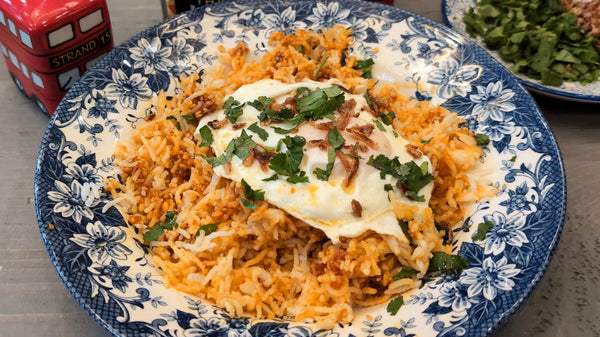
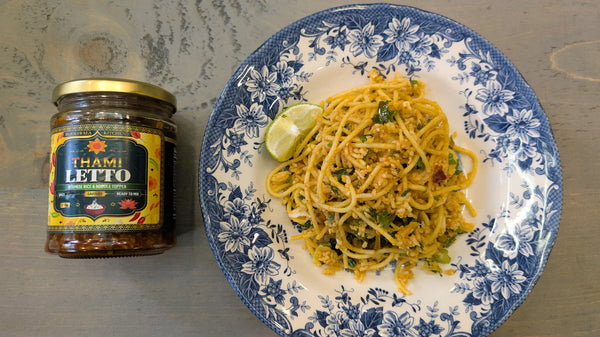
- Put a portion in a bowl and add one or two generous spoonfuls of Thami Letto.
- Mix it through with a spoon, or your hands, until every grain is coated.
- Top with chopped coriander, thinly sliced raw onion and a squeeze of lime.
- Add a fried or boiled egg if you want it more filling.
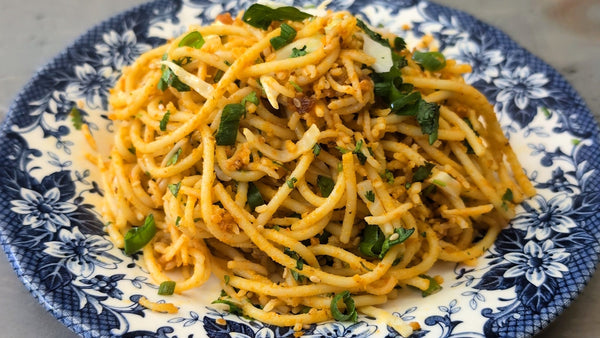
The same method works with rice noodles or egg noodles. For more ideas, see what to put on plain rice, easy rice noodle recipes and fried egg toppings.
How are Thami Letto and htamin let thok linked?
The name Thami Letto is our own rendering of htamin let thok. We wanted something that carried the spirit of the dish without being hard to pronounce on a first read.
My mother Aamna has been making this topping for over 40 years in her London kitchen. Her own mother was born in Burma, and the recipe came down to her and was refined over the years into the version that goes into the jar today. Thami Letto is that topping, ready to spoon straight onto your rice.
There are two versions. The original Fish version uses sardines, fish sauce, roasted peanuts, sesame seeds, gram flour, crispy fried onions, sunflower oil, lime juice and spices. The Vegan version leaves out the fish and uses more peanuts and sesame, which makes it richer and nuttier. Both are made by hand in small batches in Hackney.
People sometimes compare it to chilli crisp because both come in a jar and go on rice. Thami Letto is much milder and nuttier, and it is made to be mixed through rather than spooned on top. Here is how the two compare.
Questions
What does htamin let thok mean?
It means rice mixed by hand. Htamin is rice, let is hand and thok is a mixed salad.
Is htamin let thok spicy?
It is usually gently warm rather than hot. Most of the flavour comes from peanuts, sesame, fried onions and fish sauce, with chilli in the background.
Is htamin let thok vegetarian?
The traditional version uses fish sauce or dried shrimp, so it is not. It is easy to make a vegetarian or vegan version, and Thami Letto Vegan is made for exactly that.
Do you eat it hot or cold?
Both. It is often eaten warm, but it is just as good at room temperature, which is why it is a common packed lunch.
Can I use noodles instead of rice?
Yes. Rice noodles, egg noodles and even instant noodles all work with the same topping.
✦ Burmawala Kitchen ✦
Bring htamin let thok to your kitchen
Two versions. One Burmese tradition. Ready in minutes.
0 comments